Exploring parallel universes, string theory, and the possibility of 26 dimensions
What if the life you’re living right now isn’t the only version of your life? The multiverse theory raises an extraordinary possibility: that countless other realities could exist beyond our own.
Somewhere beyond our universe, could another version of you exist? Perhaps you became an astronaut instead of an accountant. Maybe you married someone different, moved to another country, or made a decision years ago that changed everything.
Could another Earth exist where history unfolded differently? One where dinosaurs never went extinct or humans have already established colonies throughout the solar system?
It sounds like science fiction. Yet some of the most intriguing ideas in theoretical physics suggest that reality could be far stranger than anything Hollywood has dreamed up.
Scientists have developed theories involving 10, 11, and even 26 dimensions. Others have proposed that our universe might be just one among countless others.
But before exploring parallel universes, there’s a more fundamental question: How much of reality are we actually capable of perceiving?
Einstein: The Man Who Changed Reality
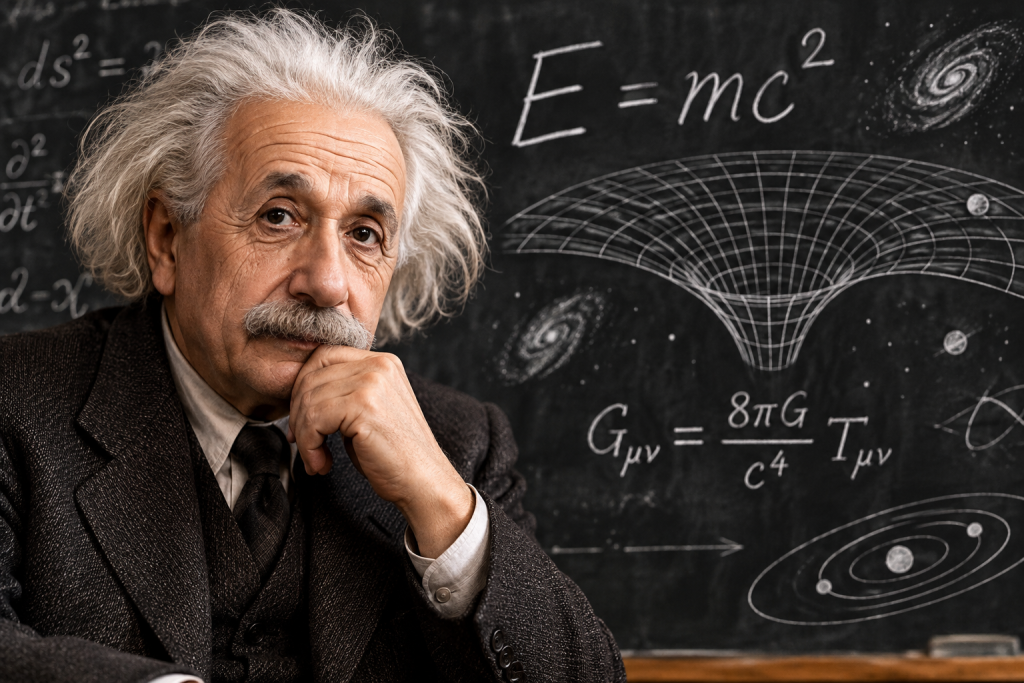
For centuries, scientists treated space and time as separate concepts. Space was where things happened, while time was the invisible clock ticking in the background.
Then Albert Einstein changed everything.
His theories of relativity revealed that space and time are interconnected, forming a four-dimensional structure called spacetime. Even more astonishing, time doesn’t pass at exactly the same rate for everyone.
Consider two identical twins. One stays on Earth while the other travels through space at nearly the speed of light. When the traveling twin returns, they could discover that their sibling has aged considerably more than they have.
That’s not science fiction. It’s a consequence of Einstein’s special theory of relativity.
Einstein never demonstrated that parallel universes exist, but his discoveries forced scientists to rethink reality. And things were about to get much stranger.
String Theory: The Universe’s Cosmic Symphony
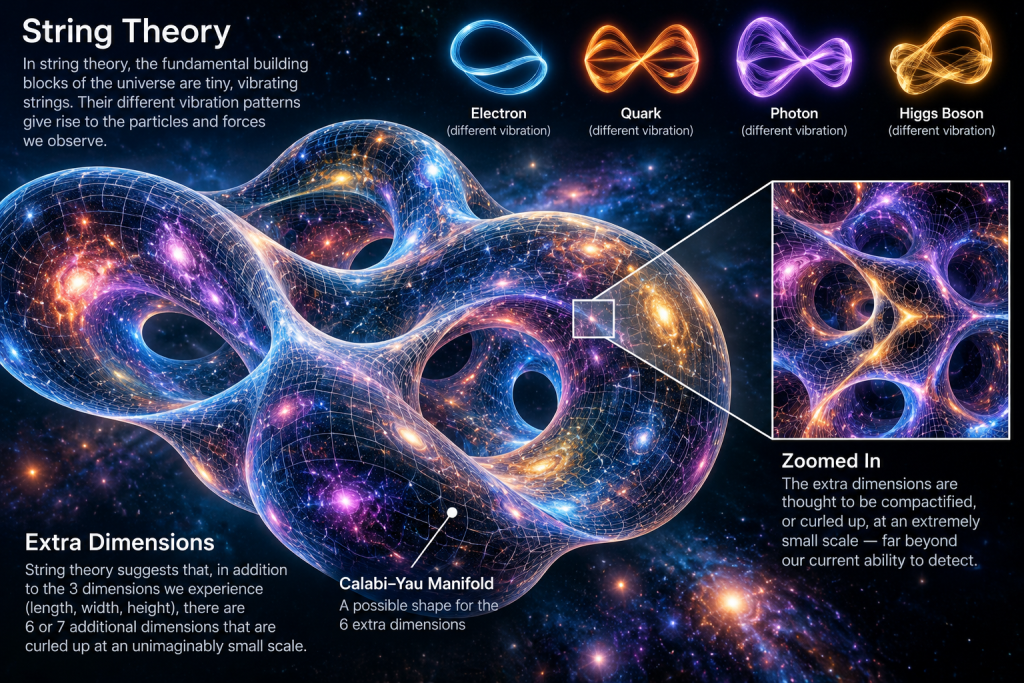
What if everything in existence—from the smallest electron to the largest galaxy—ultimately comes down to tiny vibrating strings?
That’s the central idea behind string theory.
Think about your favorite song. A guitarist strikes a chord, a bassist lays down a rhythm, and individual vibrations become music.
Now shrink that concept to a scale so small that even the most powerful microscopes cannot see it.
String theory proposes that nature’s fundamental ingredients aren’t point-like particles but incredibly tiny strings vibrating in different patterns. One vibration might correspond to an electron, while another produces a different particle.
In this theoretical picture, the universe resembles an enormous cosmic orchestra, with matter and forces emerging from these vibrations.
But when physicists worked through the mathematics, they encountered a surprise.
The strings needed more than our familiar four dimensions of spacetime.
They needed considerably more room.
Superstring Theory: Six Hidden Dimensions
Despite its name, superstring theory doesn’t involve bigger, stronger, or smaller strings.
The word super refers to supersymmetry, a proposed mathematical relationship between fermions, which include particles making up matter, and bosons, which include particles associated with forces.
Superstring theory requires 10 spacetime dimensions: three familiar spatial dimensions, time, and six additional spatial dimensions.
Where are those extra dimensions hiding?
Picture an ant crawling along a garden hose. From a distance, the hose resembles a straight line. But the ant discovers another direction: it can travel around the hose’s circumference.
Similarly, extra dimensions might be curled into extraordinarily small geometric structures, hidden from everyday observation.
Scientists haven’t confirmed that these dimensions exist. But the idea raises an intriguing question: Could something be right in front of us that we’re simply incapable of perceiving?
The Hidden Dimensions of Human Experience
We often assume that what we perceive represents everything there is to experience. Yet learning can dramatically change how we interpret the world.
Consider sitting in a restaurant surrounded by people speaking Spanish. You recognize a few words, but most of the conversation sounds unfamiliar.
Then you begin learning the language. Words become recognizable, sentences make sense, and suddenly you’re following conversations that previously seemed incomprehensible.
The conversation was always there. What changed was your ability to understand it.
In a metaphorical sense, learning another language opens a new dimension of human experience.
Mark Twain described a similar transformation in Life on the Mississippi. As he learned to navigate the river, he began recognizing currents, hazards, and subtle details that ordinary passengers overlooked.
The river hadn’t changed. His understanding had.
Now consider a professional snowboarder entering a halfpipe. A beginner sees intimidating curved walls. The professional sees angles, momentum, timing, and opportunities to launch into the air.
Both occupy the same physical space, but they interpret it very differently.
Of course, learning Spanish or mastering snowboarding doesn’t reveal an additional physical dimension. These are metaphors for how knowledge changes perception.
But they illustrate an important possibility: Our inability not to perceive something doesn’t necessarily mean it doesn’t exist.
And theoretical physics takes that question into some extraordinary territory.
M-Theory: Welcome to the 11th Dimension
Just when 10 dimensions seemed complicated enough, physicists introduced another one.
In 1995, theoretical physicist Edward Witten helped connect five different superstring theories through a broader framework called M-theory, which involves 11 spacetime dimensions.
But what does the M stand for?
Witten deliberately left the name open to interpretation. Suggested meanings include membrane, magic, and mystery.
Membranes, or branes, are higher-dimensional objects that appear in the theory’s mathematics.
Some speculative models suggest our universe could exist on a three-dimensional brane embedded within a larger, higher-dimensional space.
Other branes might exist elsewhere.
Picture a character living on a flat sheet of paper. That character understands only two spatial directions. We, however, can see the third dimension and could lift the character off the page.
Could our universe be similarly limited, with additional directions we cannot perceive?
M-theory provides a mathematical framework for exploring such possibilities, although no experiment has confirmed it.
Twenty-Six Dimensions? Now Things Get Strange
An earlier mathematical framework called bosonic string theory requires an astonishing 26 spacetime dimensions.
But don’t picture 26 alternate Earths. Dimensions and universes are not the same thing.
A dimension is an independent direction or coordinate used to describe a mathematical space.
Consider how our understanding of dimensions expands:
* One dimension: A straight line. You can move forward or backward.
* Two dimensions: A flat surface. You gain another direction of movement.
* Three dimensions: Our familiar world of length, width, and height.
* Four dimensions: Add time, creating the spacetime described by relativity.
* Ten dimensions: Superstring theory requires six additional spatial dimensions.
* Eleven dimensions: M-theory introduces another spatial dimension.
* Twenty-six dimensions: Bosonic string theory requires 25 spatial dimensions and one time dimension.
These aren’t successive discoveries of hidden worlds. They’re mathematical requirements of different theoretical frameworks.
Bosonic string theory also has significant limitations, including its inability to naturally describe the fermions that make up ordinary matter.
Still, the possibility of hidden dimensions raises another question.
If our universe contains more than we can perceive, could entirely separate universes exist as well?
Stephen Hawking: Could Our Universe Be One of Many?
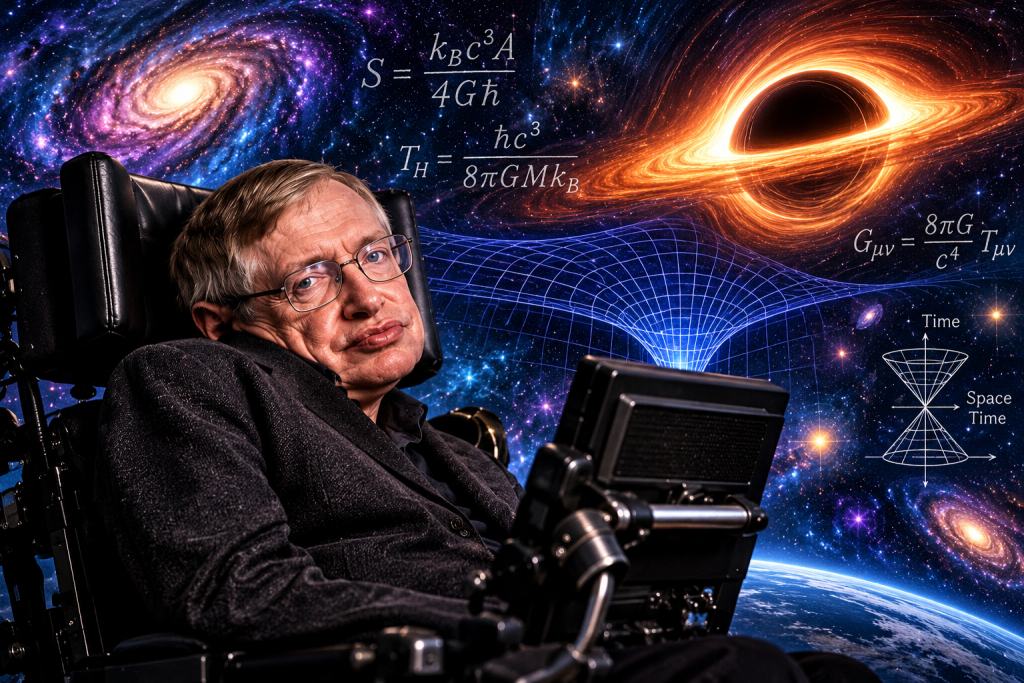
Stephen Hawking explored the possibility that our universe might be one among many.
In a scientific paper published in 2018 with physicist Thomas Hertog, Hawking investigated a more restricted version of the multiverse than some earlier proposals suggested.
Rather than an endlessly varied collection of universes, their approach suggested a more limited range of possible cosmic histories.
Why does that matter?
Because scientists need theories that can potentially produce testable predictions.
Hawking didn’t prove that parallel universes exist, but his research helped advance serious scientific discussions about the possibility.
Physicist Max Tegmark took the idea even further.
Max Tegmark: Four Levels of the Multiverse
In his book Our Mathematical Universe, physicist Max Tegmark explores four different levels of the multiverse.
Each level introduces an increasingly extraordinary possibility.
Level I: Another Earth Somewhere Out There?
Our telescopes can only observe a limited region of space because light from more distant regions hasn’t had enough time to reach us.
But what if space continues indefinitely?
If the universe is infinite and certain assumptions about the distribution of matter hold, distant regions could contain arrangements remarkably similar to ours.
Somewhere unimaginably far away, another Earth might exist.
Perhaps another version of you is reading this article right now.
These distant regions would follow the same physical laws as ours, but their histories could differ.
No duplicate Earth has been discovered, and the necessary assumptions remain unverified.
Level II: The Bubble Universes
Here’s where things get particularly interesting.
Picture our universe as one enormous bubble floating within a much larger cosmic environment.
In certain models of eternal cosmic inflation, other bubbles could form independently, each developing different physical properties.
One universe might have stronger gravity. Another could contain different particles or physical constants.
Some might never form stars, planets, or anything resembling life.
These hypothetical bubble universes could be fundamentally inaccessible to us.
It’s an extraordinary possibility, but scientists haven’t confirmed that such bubbles exist.
Level III: Another Version of You?
This level draws on the many-worlds interpretation of quantum mechanics, introduced by physicist Hugh Everett III.
According to this interpretation, different outcomes of quantum events correspond to different branches of a universal wave function.
Popular explanations compare these branches to parallel realities.
Perhaps another version of you pursued a different career, moved to another country, or experienced an entirely different life.
However, the interpretation doesn’t establish that every personal decision automatically creates another universe.
Still, it raises a fascinating question: If your life had unfolded differently, would you still be the same person?
Level IV: Universes With Entirely Different Laws
Tegmark’s fourth level is the most radical.
What if other realities don’t merely have different histories or physical constants?
What if they operate according to entirely different mathematical laws?
His mathematical universe hypothesis proposes that physical reality may itself be a mathematical structure—and that other mathematical structures could correspond to other realities.
Such universes might be so different that familiar concepts like space, time, and matter wouldn’t apply in the same way.
It’s a fascinating but highly speculative proposal.
Marvel and DC: The Multiverse Goes Hollywood

Hollywood has turned the multiverse into one of science fiction’s most entertaining concepts.
In Doctor Strange in the Multiverse of Madness, Marvel’s famous sorcerer travels through alternate realities, encountering different versions of familiar characters.
In Spider-Man: No Way Home, Peter Parker meets alternate versions of himself from other universes. By the film’s conclusion, a powerful spell causes his loved ones to forget who he is.
DC Comics explores similar ideas through characters like Superman.
In the Injustice universe, a devastating tragedy transforms Superman from Earth’s greatest protector into an authoritarian ruler.
Meanwhile, Bizarro represents a distorted counterpart to Superman, with different origins and characteristics across various stories.
These fictional universes explore a question that also makes multiverse theories compelling: Could different circumstances produce entirely different versions of ourselves?
Of course, Marvel and DC are entertainment, not scientific evidence.
But they offer a colorful way to visualize ideas that would otherwise be difficult to comprehend.
Could We Ever Travel Between Universes?
Suppose parallel universes really exist. Could humanity ever visit one?
Science fiction makes it look easy. Open a portal, step through a glowing doorway, and suddenly you’re standing on an alternate Earth.
Real physics isn’t quite so accommodating.
Some theoretical models describe wormholes—hypothetical shortcuts through spacetime.
However, scientists have never confirmed a traversable wormhole, and no demonstrated method exists for traveling between universes.
Even if extra dimensions exist, they wouldn’t automatically provide doorways to alternate realities.
For now, interdimensional travel remains science fiction.
Where Do We Fit Into All of This?
After exploring string theory, hidden dimensions, bubble universes, and alternate realities, it’s worth returning to something familiar.
Earth.
Our planet is approximately 4.5 billion years old, orbiting an ordinary star in a galaxy containing billions of other stars.
Beyond the Milky Way lie countless galaxies stretching across the observable universe.
And somewhere on this tiny planet, we’re asking whether everything we can see represents only a fraction of reality.
Perhaps additional dimensions exist beyond our ability to perceive them. Perhaps our universe is one among many. Or maybe future discoveries will reveal something stranger than any theory we’ve developed.
For now, we simply don’t know.
But consider one final possibility.
Somewhere beyond everything we can observe, another civilization might be looking toward the stars, wondering whether they’re alone.
Perhaps another version of you is asking exactly the same question.
And perhaps the greatest mystery isn’t whether other universes exist.
It’s how much of reality we have yet to discover.
Keep looking up.
SpaceTryst — Exploring the Universe and Beyond.