From Survival to System
When Neil Armstrong stepped onto the Moon, his suit was survival.
Layered fabric. Pressure bladders. Oxygen circulating through tubes. A backpack that functioned as a portable life-support system. It kept him alive for a few hours on an airless world.
That was enough.
The Apollo suits were engineering marvels — but they were reactive. They protected against vacuum and temperature extremes. They did not assist movement. They did not anticipate danger. They did not process information.
They were shields.
By the era of the International Space Station, the suit evolved again. The Extravehicular Mobility Unit became modular and more dexterous. Astronauts repaired solar arrays while orbiting Earth at 17,500 miles per hour.
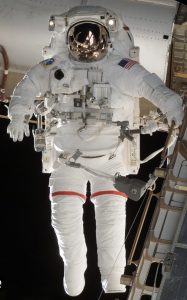
Still, it was a tool.
Now we are standing at the edge of something different.
With Artemis, NASA’s next-generation lunar suit — the xEMU and its evolved Axiom design — is built not just to walk, but to work. It allows astronauts to bend at the waist, rotate at the hips, and crouch to pick up objects. It supports surface operations for up to eight hours and is engineered for the Moon’s abrasive regolith and extreme temperature swings.
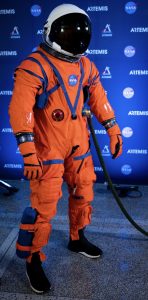
Mobility is no longer secondary.
But even Artemis is a bridge.
The real transformation is still ahead.
Inside the Helmet
Imagine standing on Mars.
Not watching it. Standing on it.
Rust-colored dust settles around your boots. The horizon curves gently. The sky is thin, tinted copper.
Inside your visor, a faint grid overlays your vision.
Radiation: stable.
External temperature: –42°C.
Oxygen reserve: 87%.
Heart rate: 98 bpm.
Hydration: optimal.
With a subtle hand motion, terrain mapping appears. Stable ground glows green. Loose regolith shifts amber. A route to the construction site pulses at the edge of your field of view.
Your suit isn’t just keeping you alive.
It’s thinking with you.
Embedded sensors detect stress in the outer shell and seal micro-fractures before you notice them. Internal systems redistribute pressure as you climb. An exoskeletal frame amplifies your strength, responding before strain builds.
You lift a structural beam.
Mars’ lighter gravity helps — but the suit helps more. Micro-actuators assist the motion. The beam rises smoothly.
You push off the ground.
For a moment, you glide.
The suit stabilizes you midair, correcting balance in milliseconds before you land.
You are not fragile.
You are augmented.
Humans in a Network
You are not alone inside your helmet.
The same system assisting your muscles and monitoring oxygen extends beyond you.
Your suit does not end at the fabric.
It reaches outward.
Around you, robots move in coordinated silence.
Autonomous units print regolith into hardened walls. Drones scan terrain and feed updates into your visor. Rovers transport materials between work zones.
Suit-to-rover.
Suit-to-drone.
Suit-to-habitat.
Your suit is not just protecting you.
It is linking you.
Biometric data streams back to the colony’s central system. Exertion, oxygen use, recovery time — all tracked. Tomorrow’s assignments adjust automatically.
You glance at another crew member fifty meters away. Through blowing dust, their status remains visible. Oxygen stable. Heart rate steady.
No constant radio chatter.
The network handles that.
Each suit is a node.
Each human is part of a distributed planetary system.
The First City Is Built With the Suit
Cities don’t begin with skylines.
They begin with movement.
Your visor shifts to infrastructure mode.
Habitat perimeter: marked.
Radiation shielding: insufficient in sector three.
Suggested regolith reinforcement path: highlighted.
You kneel — easily. Artemis-level joints allow a full range of motion. Micro-actuators reduce strain in your hips and spine.
On Apollo, this would have been awkward.
Here, it feels natural.
You anchor a solar array. The suit stabilizes your posture on uneven terrain. A dust gust hits; abrasion sensors respond instantly. The outer shell stiffens microscopically to compensate.
A drone hovers overhead. Structural stress data appears in your display before you ask for it.
You are not just building.
Your suit is interpreting the environment with you.
Later, inside a partially pressurized shell, the suit transitions modes. External radiation alerts dim. Internal air-quality diagnostics rise in priority.
Your heart rate slows.
Hydration reminder pulses softly.
Even indoors, the system continues — filtering particulates, logging metabolic recovery, tracking long-term health trends.
The city does not begin with walls.
It begins with augmented humans stepping outward, carrying infrastructure on their backs.
A hundred suits working in coordination are not just workers.
They are a mobile operating system for a new world.
The Next Step
For most of human history, clothing protected us from weather.
Soon, clothing will protect us from worlds.
But protection is only the beginning.
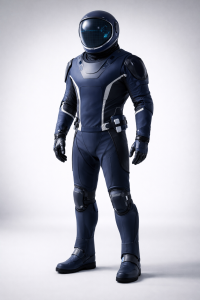
The future spacesuit will monitor, guide, strengthen, and connect. It will blur the line between astronaut and infrastructure. It will turn a single human into a capable unit of planetary construction.
The first astronauts wore suits to survive.
The Artemis generation will wear them to work.
And the generation that follows may wear them to build.
Before Mars, there is the Moon. Artemis will test mobility, endurance, and long-duration surface operations. It will refine the systems that eventually scale outward.
The suit will evolve there first.
Then farther.
When we look back decades from now at the first permanent settlement beyond Earth, the turning point may not be a rocket launch or a landing.
It may be quieter.
It may be the moment the spacesuit stopped being fabric and became system.
When what we wore allowed us not just to survive another world —
but to shape it.