Mars won’t become a living world overnight.
It won’t begin with oceans, forests, or blue skies.
It will begin quietly—
with machines.
Before the first permanent human steps onto Martian soil, robots will already be there. They’ll level the ground, construct landing pads, assemble power systems, and begin building the first structures designed to support life.
Not a colony.
Not a city.
Just the beginning.
A foothold on another world.
But once that foothold is secured… something much bigger begins.
From Machines to Meaning
The early days of Mars will feel industrial.
Metal. Dust. Silence.
Habitats will be sealed. Life will exist inside controlled environments, protected from radiation, extreme cold, and a thin, unforgiving atmosphere.
But beneath all of that… Mars holds something incredibly important.
Water.
Scientists already believe that Mars contains vast reserves of ice—and possibly even liquid water—beneath its surface. Not oceans like Earth’s, at least not yet, but something just as valuable:
Potential.
Because once you have water…
you can begin to shape a world.
From Ice to Oceans
At first, water will be used carefully.
Extracted. Melted. Stored.
It will support survival—drinking, growing food, sustaining life inside controlled habitats.
But over time, as technology advances, water will begin to take on a larger role.
• Subsurface ice turned into reservoirs
• Engineered man-made lakes forming near settlements
• Water systems expanding outward from each new outpost
Mars won’t flood overnight.
It will be cultivated—deliberately, patiently, step by step.
And those first lakes?
They won’t just reflect the sky.
They’ll reflect something much bigger:
Humanity’s first attempt at reshaping an entire planet.
The First Green on Mars
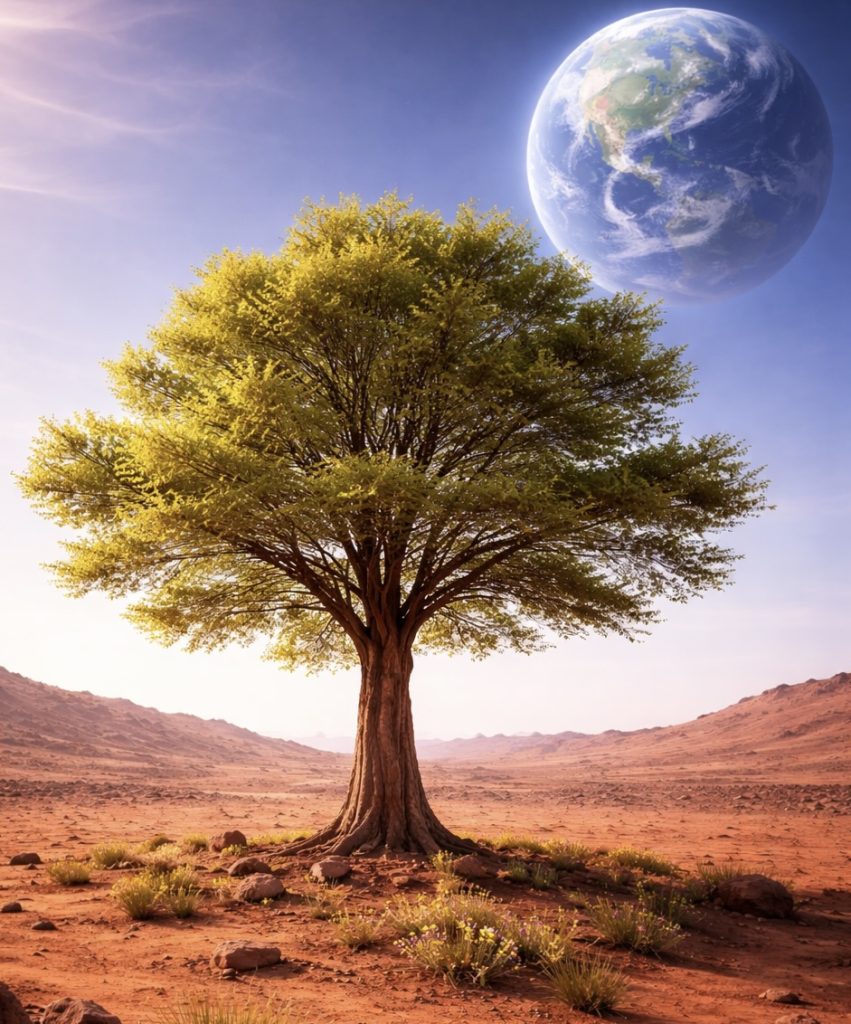
Mars receives enough sunlight to support plant life—especially within protected environments.
So not long after water comes life.
Greenhouses will rise alongside habitats:
• Crops grown in controlled domes
• Oxygen slowly produced through plant systems
• Food grown locally instead of shipped from Earth
At first, it’s survival.
But then something shifts.
Because eventually, someone will plant something not just for survival…
but for meaning.
The first tree on Mars.
Not dropped there randomly—but chosen, protected, nurtured.
A symbol.
Like a squirrel burying seeds before winter—
only this time, the seed becomes the beginning of a new ecosystem.
Adding Color to a Red World
Today, Mars is a planet of rust.
Endless red dust stretching across silent landscapes.
But that won’t always be the case.
As human presence expands, so will color:
• Green from plant life spreading outward
• Blue from artificial lakes forming on the surface
• Light reflecting differently as structures and ecosystems evolve
Mars won’t transform all at once.
But over time…
It won’t look like the Mars we see today.
It will begin to feel alive.
Can We Build a Sky?
This is where the vision becomes bigger.
Because changing the surface is one thing.
Changing the sky… is something else entirely.
Could we ever give Mars an atmosphere dense enough to support life?
To do that, humanity would need to:
• Release massive amounts of gas into the atmosphere
• Increase planetary temperature to prevent atmospheric loss
• Potentially create systems that mimic or rebuild an ozone layer
It’s one of the most ambitious ideas ever imagined.
But if it worked…
Mars might one day have blue skies.
Not tomorrow.
Not in the near future.
But in the long arc of human history?
It’s a possibility worth asking.
From Outpost to Town
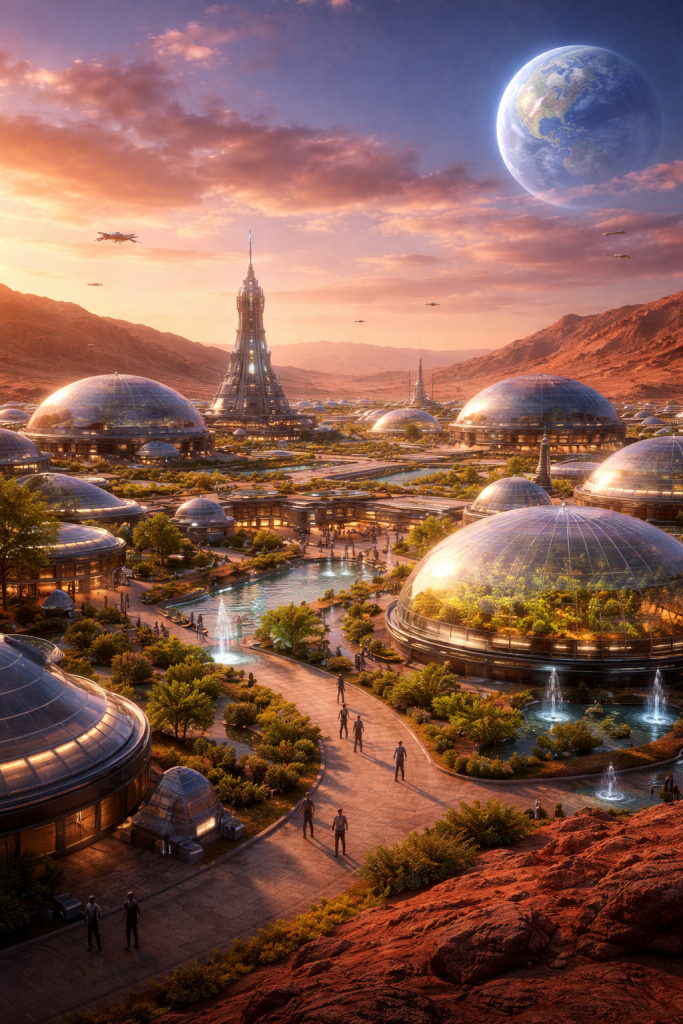
Every great civilization starts small.
Mars will be no different.
At first:
• A research station
• A few connected habitats
• A small team of scientists and engineers
Then slowly:
• More people arrive
• Systems stabilize
• Infrastructure expands
Until one day…
It’s no longer just a base.
It’s a town.
The first town on Mars.
A place where people don’t just survive—
they begin to live.
The Greatest Garden Ever Planted
Mars won’t become Earth overnight.
It will require something more than technology.
It will require care.
The first colonists won’t just be explorers—they’ll be caretakers.
They will:
• Manage fragile ecosystems
• Expand life into controlled and then semi-controlled environments
• Protect what they create from collapse
Mars will become something humanity has never built before:
A planet that must be nurtured like a garden.
And like any garden…
It won’t grow unless it’s cared for.
The First Generation
At some point, something extraordinary will happen.
A child will be born on Mars.
The first human who has never lived on Earth.
That moment changes everything.
Because Mars is no longer just a mission.
It’s no longer just an experiment.
It becomes a home.
And that first generation will grow up seeing two worlds:
The one humanity came from…
and the one it chose to build.
One Day, This Will Be History
It’s hard to imagine now.
But one day, the colonization of Mars may be taught in classrooms the same way we learn about:
• The first human settlements on Earth
• The development of agriculture
• The rise of early civilizations
What feels impossible today…
Could become something future generations see as inevitable.
Just another step in the story of humanity.
But What If Mars Isn’t Empty?
Before we reshape Mars…
we have to ask something deeper.
What if life already exists there?
Not cities.
Not intelligent civilizations.
But something older.
Something microscopic… or even long extinct.
Imagine this:
A future mission begins a deep archaeological-style excavation beneath the Martian surface.
Not just drilling for water—but searching.
Layer by layer, the planet’s history is uncovered.
And then…
Something unexpected appears.
A structure.
A fossil.
The skeletal remains of something that once lived.
Not human.
Not from Earth.
Proof that Mars wasn’t always silent.
Who knows what we might find.
But if we discover that life once existed on Mars…
then the universe suddenly feels a lot less empty.
What Comes Next
And that leads to a much bigger question.
If Mars holds signs of life—past or present—
Then what about everywhere else?
Are we alone in the universe?
Or are we just one small part of something far greater?
Maybe there’s a deeper design behind it all.
A higher order we’re only beginning to understand.
Because the moment we find life beyond Earth…
Everything changes.
Next on SpaceTryst
The search for intelligent life in the universe—and what it means for humanity’s place in it.