When humans finally step onto Mars, they won’t be arriving in an untouched wilderness.
Mars is not a place of forests or oceans. It’s a vast red desert — a landscape of dust plains, frozen ground, jagged rock fields, and towering volcanoes. The sky is thin and pale. The air is almost nonexistent. Temperatures regularly plunge far below anything humans experience on Earth.
It’s a world that does not easily welcome visitors.
And long before the first astronaut climbs down the ladder of a spacecraft, something else will already be there — working quietly in the dust.
Robots.
These robotic builders won’t breathe, sleep, or eat. They won’t need radiation shielding, pressurized habitats, or months of training for survival. Instead, they will arrive years earlier, preparing the planet for the moment humans finally follow.
In many ways, the first Martian settlement may begin not with astronauts — but with machines.
Preparing Mars for Human Arrival
Sending humans to Mars is one of the most complex missions humanity has ever attempted.
A single journey could take six to nine months, and once astronauts arrive, the environment offers little protection from radiation, extreme cold, or violent dust storms that can cover the entire planet.
Before humans can safely live and work there, basic infrastructure must exist.
Landing zones must be prepared so spacecraft can touch down safely.
Power systems must be installed to generate electricity.
Habitats must be constructed to protect crews from radiation and temperature swings.
On Earth, construction crews would handle these tasks.
On Mars, robots will likely do the job first.
Builders From Another World
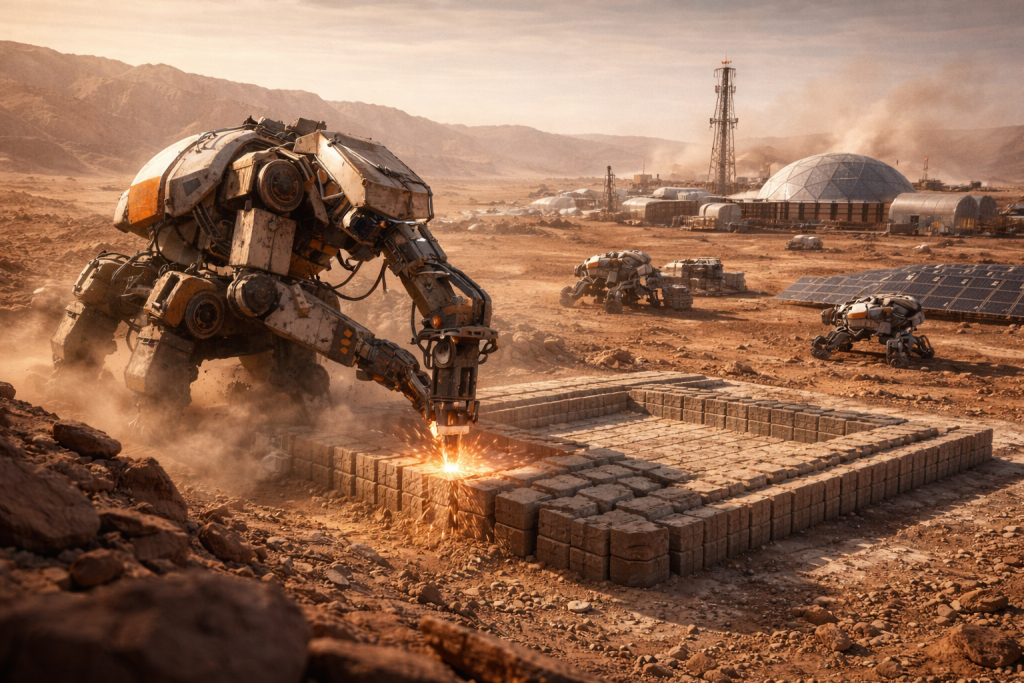
Robotic construction machines could take many forms.
Some may resemble autonomous bulldozers that level terrain for landing pads. Others could deploy solar farms across the Martian surface or assemble prefabricated habitat modules delivered from Earth.
One of the most promising ideas involves using Martian soil itself as a building material.
Scientists call this soil regolith, and researchers are already experimenting with ways to melt or bind it into strong construction materials. Robotic systems could use large-scale 3D printing techniques to turn this dust into landing pads, roads, or protective walls.
This approach is crucial for Mars missions.
Every kilogram launched from Earth requires enormous energy and cost. If construction materials can be created directly on Mars, future missions become far more practical.
In other words, the first Martian base may literally be built from Mars itself.
Robots and Humans Working Together
Not all of these machines will be operating completely on their own.
Some will likely be controlled directly from Earth.
Engineers could guide robotic construction equipment remotely, helping assemble structures, repair systems, or adjust plans as conditions change on the Martian surface. Communication delays between Earth and Mars — which can reach up to twenty minutes — mean these robots will still need a degree of autonomy to function effectively.
That’s where artificial intelligence comes in.
Future robotic builders may combine remote human guidance with AI systems that allow them to navigate terrain, avoid hazards, and complete construction tasks independently.
It becomes a partnership.
Humans provide strategy and oversight from millions of miles away.
Robots provide the hands that actually build.
Why the Machines Go First
Robots can survive environments that would be extremely dangerous for humans.
They don’t require oxygen, water, or food. They can operate continuously for years. If something fails, another machine can take its place.
By the time astronauts finally arrive, the essentials of a Martian outpost could already be waiting for them.
Landing pads prepared for incoming spacecraft.
Power systems generating electricity.
Habitats standing against the cold and radiation.
Companies like SpaceX, which is developing the massive Starship rocket for future Mars missions, envision sending cargo and infrastructure ahead of human crews. Robotic builders could play a critical role in preparing those first landing sites.
When the first astronauts step onto Mars, they may find that the groundwork for their survival has already been laid.
The First Martian Construction Site
Imagine the scene.
A dusty plain beneath the pale salmon sky of Mars.
Solar panels stretch across the red horizon. A habitat stands quietly nearby, assembled piece by piece by machines that arrived years earlier.
A robotic arm tightens the final bolt on a structure designed to support human life on another world.
Then a spacecraft appears in the thin Martian sky.
For the first time in history, humans descend onto the surface of another planet — not as visitors, but as settlers.
And waiting there in the dust is the construction crew that made it possible.
Not humans.
Robots.
As robotic construction technology advances, the idea of machines preparing entire worlds for
human arrival is moving from science fiction into real engineering. The first Martian landing
sites may eventually grow into something much larger — permanent research bases, industrial
hubs, and perhaps even the early foundations of cities on another planet. In the next
SpaceTryst post, we’ll explore how those first habitats might actually be built, from radiation-
shielded living quarters to the closed-loop life-support systems that could allow humans to live
on Mars for months — or even years at a time.