The First Astronauts Weren’t Just Pilots — They Were Risk Takers Testing the Edge of Space
Now that we’re beyond the edge of space, the 2050 Astronauts will be more than risk takers, they will be technological wizards.
In the earliest days of spaceflight, astronauts were not “just” pilots.
They were test pilots — elite aviators selected because they were already pushing experimental aircraft to their limits. Many had flown rocket planes and high-altitude jets, gathering data on vehicles that barely held together at the edge of the atmosphere.
When NASA launched the Mercury and Apollo programs, those same individuals were chosen for a new kind of test.
Not just aircraft.
Spacecraft.
They were the first humans to strap themselves to controlled combustion and ride them into orbit — or beyond it.
Later generations of astronauts evolved into scientists and engineers. By the era of the International Space Station (ISS), crew members were running laboratories in microgravity, conducting biomedical research, repairing complex robotics, and managing orbital infrastructure.
But by 2050, the astronaut may evolve again.
The future astronaut will not just operate machines.
They will collaborate with intelligence.
From Operators to System Integrators
Today’s astronauts are already more than pilots. Missions through NASA and companies like SpaceX require crew members to manage robotics, conduct research, maintain spacecraft systems, and coordinate constantly with mission control.
But future missions — especially to Mars — introduce new constraints:
• Communication delays up to 20 minutes each way
• Increased radiation exposure
• Psychological isolation
• Limited real-time support from Earth
On Mars, waiting for instructions is not an option.
Autonomy becomes mandatory.
And we are already testing that shift in orbit.
Aboard the International Space Station, NASA operates three cube-shaped, free-flying robots: Honey, Bumble, and Queen.
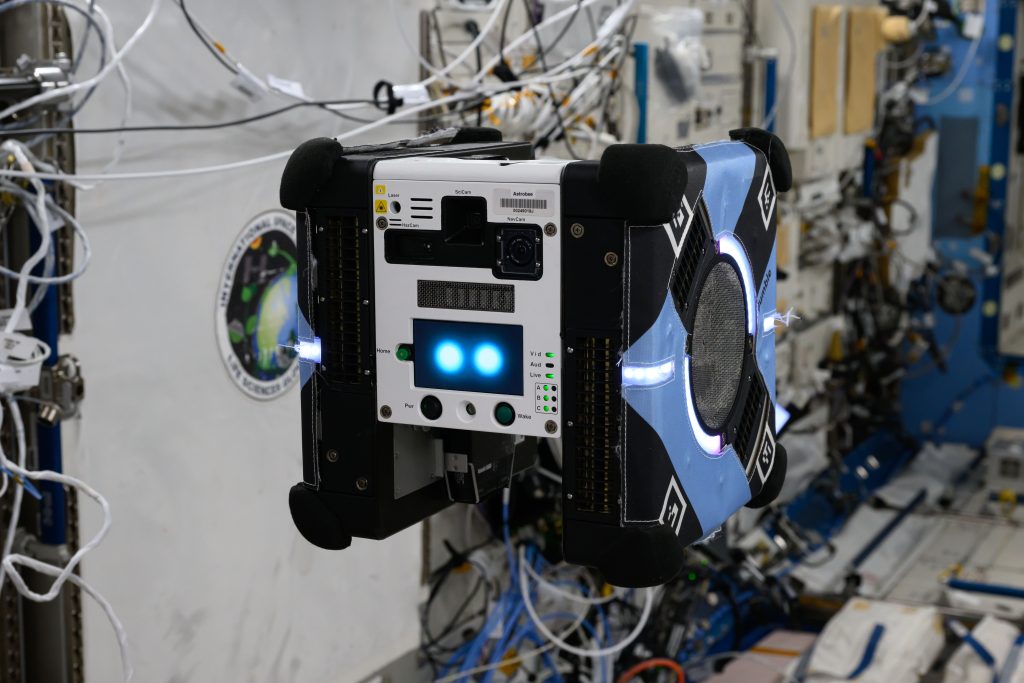
Known collectively as Astrobee, these fan-propelled autonomous systems float through the station assisting astronauts with:
• Inventory tracking
• Environmental monitoring
• Cargo management
• Technology testing in microgravity
But Astrobee is more than a helper robot.
It is a research platform.
Engineers use it to test autonomous navigation, docking procedures, perching mechanisms, and onboard decision-making in real space conditions.
It is an early prototype of something larger.
Right now, astronauts supervise Astrobee.
By 2050, astronauts may command entire fleets of its descendants.
The AI Copilot Era
Imagine stepping onto Mars and glancing at your helmet visor.
Instead of a static view, you see layered intelligence:
• Radiation exposure levels
• Structural stability readings
• Terrain hazard mapping
• Equipment diagnostics
• Habitat system health
Think less checklist binder.
More embedded mission intelligence.
The machine handles pattern recognition.
The human provides judgment.
By mid-century, astronauts may operate alongside embedded AI systems capable of:
• Real-time hazard detection
• Predictive equipment diagnostics
• Autonomous navigation assistance
• Adaptive mission planning
The astronaut becomes less of a procedure executor — and more of a strategic decision-maker.
The Intelligent Suit
Modern space suits already regulate temperature, remove carbon dioxide, and provide life support.
By 2050, they could evolve into intelligent exo-systems.
Possible advancements include:
• Strength-assist exoskeletons
• Continuous biometric monitoring with adaptive life support
• Real-time radiation exposure tracking
• Neural interface controls for robotic tools
On Mars, gravity is one-third of Earth’s. Muscles weaken more quickly in reduced gravity environments. A strength-assist system could reduce injury and increase endurance.
The suit stops being a garment.
It becomes a wearable spacecraft and muscular skeleton.
Psychological Evolution
Technical skills alone will not define the astronaut of 2050.
Long-duration missions demand:
• Emotional resilience
• Isolation tolerance
• Conflict management
• Cognitive adaptability
AI may assist with mental health monitoring, identifying stress patterns early.
But intelligence systems cannot replace human connection.
Future crews may be selected less like pilots — and more like interdisciplinary systems thinkers.
Engineers who understand biology.
Scientists comfortable with robotics.
Leaders capable of managing both machines and humans.
A New Archetype
The astronaut of 2050 may be:
• A robotics engineer
• A software systems architect
• A biomedical specialist
• A planetary infrastructure coordinator
They will train not only in mechanics and survival — but in AI collaboration.
They won’t just explore terrain.
They will manage intelligent networks.
The Larger Shift
This transformation reflects a broader human pattern.
We relied first on physical strength.
Then mechanical power multiplied our output.
Now computational intelligence extends our decision-making.
Space exploration mirrors that trajectory.
The astronaut of 2050 is not a lone hero planting flags.
They are a node in a distributed intelligence network — human and artificial.
Mars will not be built by individuals.
It will be built by coordinated systems.
And the astronaut will stand at the center of that collaboration.
But here’s the part we rarely think about:
It takes more than a decade to train an astronaut.
Years of education.
Years of physical conditioning.
Years of simulations, survival training, systems mastery.
The astronaut who steps onto Mars in 2050 may already be alive today.
They might be sitting in an elementary school classroom right now — learning math, struggling through science homework, building LEGO robots, staring at a poster of the solar system on the wall.
They don’t yet know they are training for a planet.
But they are.
Because by the time they arrive, they won’t just operate spacecraft.
They will manage intelligence.
They will wear suits that think and command robotic fleets descended from Astrobee — collaborating with systems more powerful than any mission control in history.
And when they look through their visor — layered with data, diagnostics, and AI guidance — they won’t see science fiction.
They will see the next phase of humanity.
The astronaut of 2050 is not just a future profession.
It is a future mindset.
And somewhere, right now, that mindset is sitting in a classroom — quietly preparing to walk on Mars without realizing it. The astronauts of the future are our children.