We landed humans on the Moon more than half a century ago.
So why haven’t we been back?
That question is almost impossible not to ask when you look at the history of human spaceflight. Neil Armstrong and Buzz Aldrin first walked on the Moon in 1969. Over the next three years, five more Apollo missions successfully landed astronauts there. By the time Apollo 17 left the lunar surface in December 1972, twelve people had walked on another world.
And then we stopped.
Think about that for a moment.
In the early 1970s, astronauts were driving a rover across the Moon, collecting rocks and conducting experiments. More than five decades later, no human being has traveled beyond low Earth orbit since Apollo 17.
We proved we could get there.
What we never did was take the next logical step: start building something.
That is what makes Artemis IV so interesting.
NASA is currently targeting Artemis IV for early 2028 as the first crewed lunar landing of the Artemis era. Four astronauts will travel aboard Orion to lunar orbit, where two will transfer to a commercial lunar lander and descend to the lunar South Pole for approximately a week.
But this isn’t supposed to be Apollo all over again.
The larger objective is to establish a sustained human presence on and around the Moon, with robotic and crewed missions gradually putting the equipment and infrastructure in place to make that possible.
This time, the goal isn’t just getting there.
It’s learning how to stay.
Why Did We Leave the Moon?
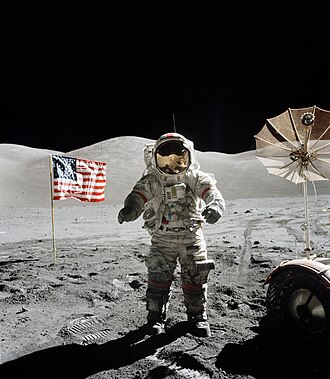
The answer isn’t that we somehow forgot how to get there.
Apollo was enormously expensive, and it was created during the Cold War space race between the United States and the Soviet Union. Once the United States accomplished President John F. Kennedy’s goal of landing astronauts on the Moon and returning them safely to Earth, political priorities and budgets changed.
Apollo 18, 19 and 20 were ultimately canceled.
NASA moved into a different era—Skylab, the Space Shuttle, the International Space Station and decades of learning how humans can live and work for extended periods in low Earth orbit.
Those programs produced enormously valuable science and technology.
But the Moon remained empty.
Now NASA is preparing to take the next step, and getting there again will involve a very different system than Apollo.
Artemis III: The Rehearsal Before the Landing
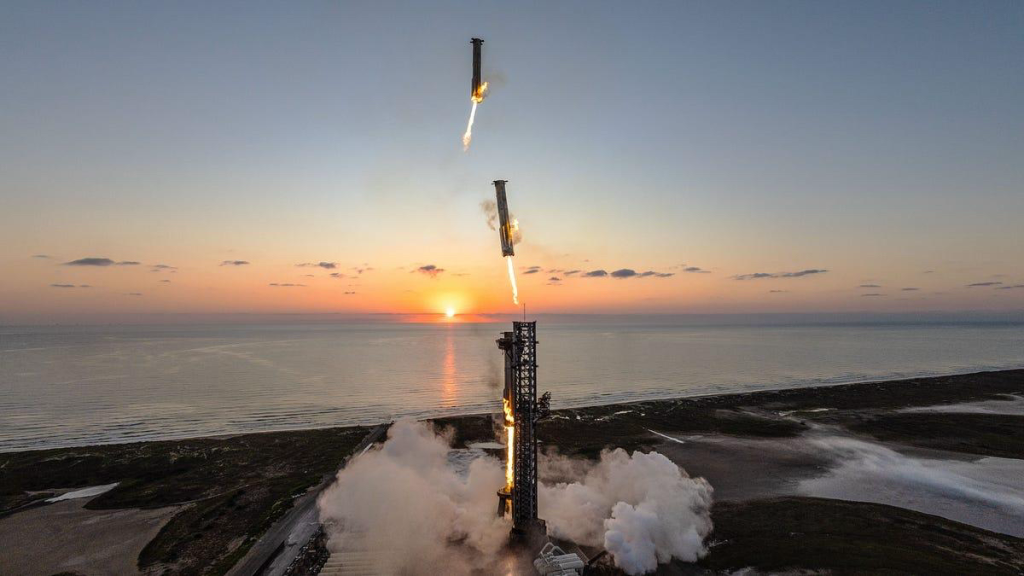
Before Artemis IV heads for the lunar surface, Artemis III is intended to test one of the most important parts of the new architecture.
NASA plans to launch astronauts aboard Orion into Earth orbit in 2027 and practice rendezvous and docking operations with test versions of commercial lunar landers being developed by SpaceX and Blue Origin.
Why does that matter?
Because Orion doesn’t land on the Moon.
Orion carries astronauts through space, but reaching the lunar surface requires another spacecraft—a human landing system. Orion and the lander therefore have to find each other in space, maneuver together, dock safely and allow astronauts to transfer between them.
SpaceX is developing a lunar version of Starship, while Blue Origin is developing its Blue Moon system. NASA says the readiness of the commercial landers will determine which provider ultimately carries the Artemis IV astronauts to the surface.
Think of Artemis III as the rehearsal.
Artemis IV is when the curtain goes up.
Artemis IV: Back to the Moon
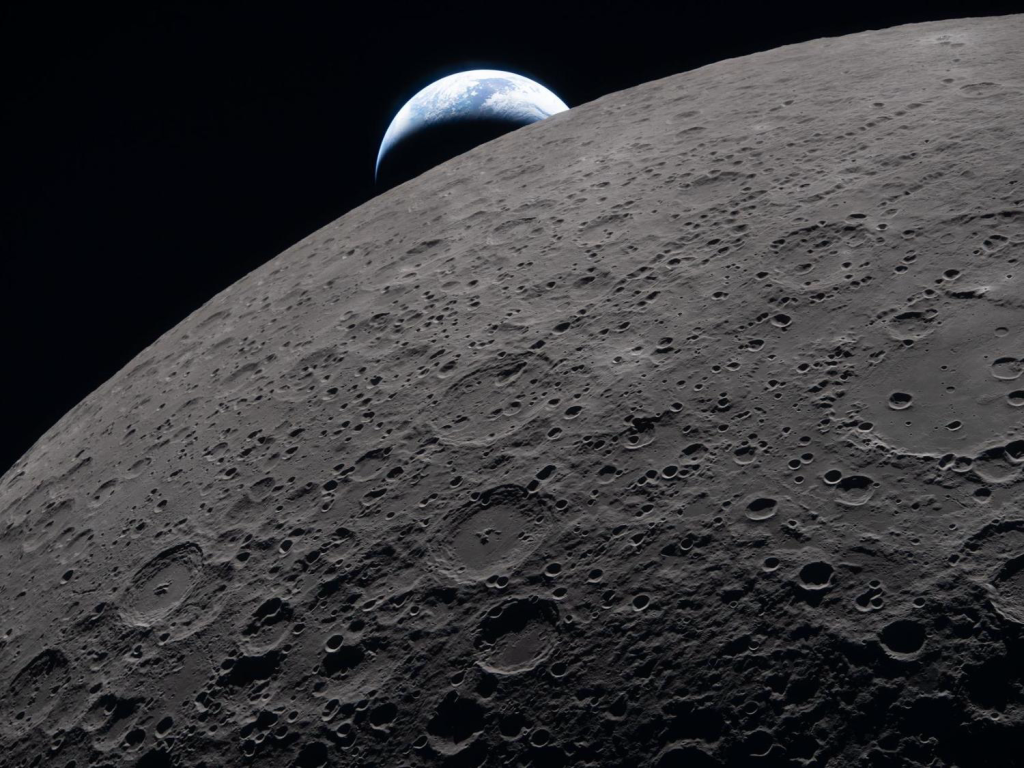
Imagine you’re one of four astronauts aboard Orion approaching the Moon.
A commercial lunar lander is waiting for you.
Orion approaches and docks with it.
Two astronauts transfer into the lander while the other two remain aboard Orion.
Then the lander separates.
You begin descending toward the lunar South Pole.
For the first time since Apollo 17, human beings are heading toward the lunar surface again.
The lander touches down.
You climb outside.
But unlike the Apollo astronauts, you may not be arriving at a completely empty landing site.
Equipment and robotic vehicles could increasingly be delivered to the lunar surface ahead of crews. Future lunar terrain vehicles are being designed with autonomous capabilities, allowing machines to perform useful work even when astronauts aren’t there.
Imagine stepping onto the Moon and discovering that some of your equipment has already been operating there.
That changes the entire idea of a Moon mission.
Instead of astronauts bringing everything with them, doing their work and leaving, each mission can begin contributing to something larger.
Building a Base Piece by Piece
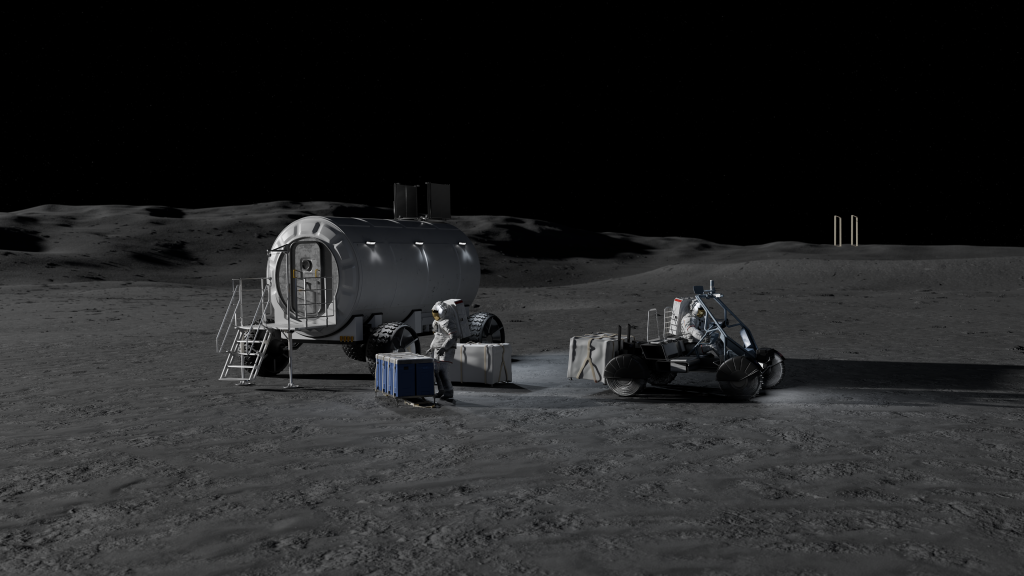
A Moon base isn’t going to arrive aboard one giant rocket.
It will grow one mission at a time.
Cargo landers can bring equipment and supplies. Rovers can explore the terrain and transport cargo. Communications equipment can connect crews with Earth. Power systems can keep increasingly sophisticated machinery operating. Habitats can eventually allow astronauts to stay for longer periods.
And crucially, equipment doesn’t necessarily have to stop working when the astronauts leave.
That is one of the biggest differences between simply visiting the Moon and actually establishing a presence there.
The first lunar base probably won’t resemble the sprawling science-fiction cities we see in movies. It may initially look more like a remote construction site scattered across the gray lunar landscape.
A lander here.
A rover there.
Power equipment nearby.
Scientific instruments operating in the distance.
Perhaps a habitat waiting for the next crew.
And some of the workers building that outpost may eventually not be human at all.
Could Optimus or Atlas Eventually Work on the Moon?
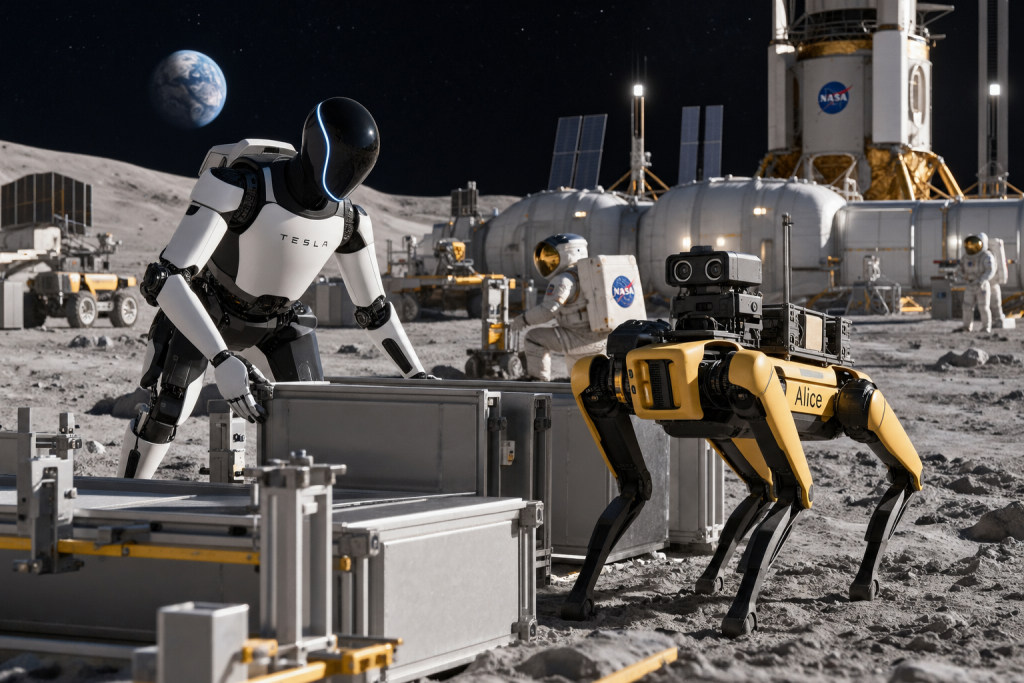
NASA is already developing robotic systems and autonomous vehicles for lunar exploration.
But imagine taking that idea another step.
Tesla is developing Optimus, a general-purpose humanoid robot. Boston Dynamics is developing its electric Atlas, another humanoid machine designed to perform complicated physical tasks.
Neither Optimus nor Atlas is currently part of Artemis IV or NASA’s Moon Base program.
But robots descended from technologies like these raise an intriguing possibility for future lunar construction.
A robot doesn’t need oxygen.
It doesn’t need food or drinking water.
It doesn’t need to sleep.
And if something goes wrong while it’s performing a dangerous job, a human life isn’t lost.
Today’s humanoid robots obviously couldn’t simply be loaded onto a rocket and dropped onto the Moon.
The environment is brutal.
Lunar dust is extremely abrasive. Radiation is a constant concern. Temperatures can be extreme. Electronics, batteries, joints, lubricants and other components would have to be redesigned to survive prolonged operation on the lunar surface.
But those are engineering problems.
And engineering changes quickly.
A Robotic Workforce on the Moon
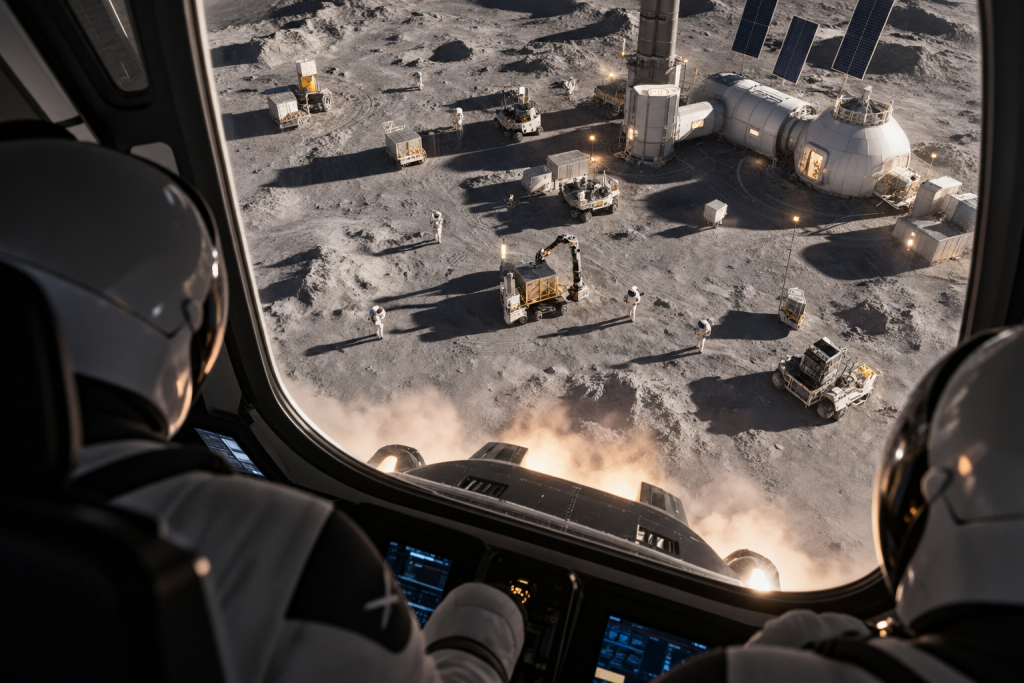
Imagine lunar-rated robots arriving aboard cargo missions before the astronauts.
One inspects equipment.
Another surveys a potential construction area.
Rovers move cargo across the surface.
Then Orion arrives.
Two astronauts descend in their lander and join machines that have already been working.
A humanoid robot helps unload equipment.
Another moves construction materials.
Autonomous rovers transport heavier cargo.
The astronauts concentrate on jobs requiring human judgment, problem-solving and improvisation while machines handle some of the repetitive, exhausting or dangerous physical labor.
Suddenly the question isn’t simply:
How much can two astronauts accomplish on the Moon?
It becomes:
How much can two astronauts accomplish with an entire robotic workforce helping them?
The first real construction crews on another world might eventually consist of both humans and machines.
Powering Life on the Moon
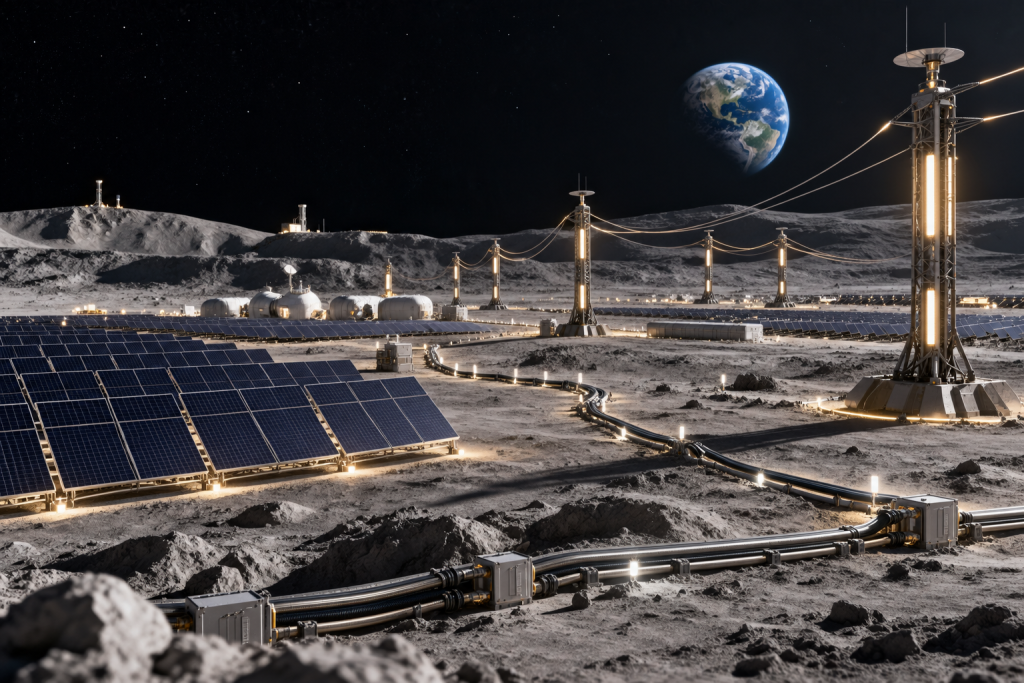
Of course, astronauts, robots and habitats all create another enormous challenge.
Electricity.
Habitats need power.
Communications systems need power.
Rovers and robots need to recharge.
Scientific instruments need electricity.
Equipment designed to extract and process lunar resources will need power as well.
Solar energy will almost certainly play an important role, but NASA and the Department of Energy are also pursuing another possibility: nuclear fission power on the Moon.
A compact lunar reactor could eventually provide dependable electricity without relying entirely on sunlight.
That could become especially important as a lunar outpost grows.
Instead of thinking about one spacecraft and a few experiments, imagine an entire network operating on the surface: habitats, communications systems, scientific equipment, rovers, robots and machinery processing lunar resources.
At that point, we’re no longer talking about visiting the Moon.
We’re talking about operating there.
Why Build at the Lunar South Pole?
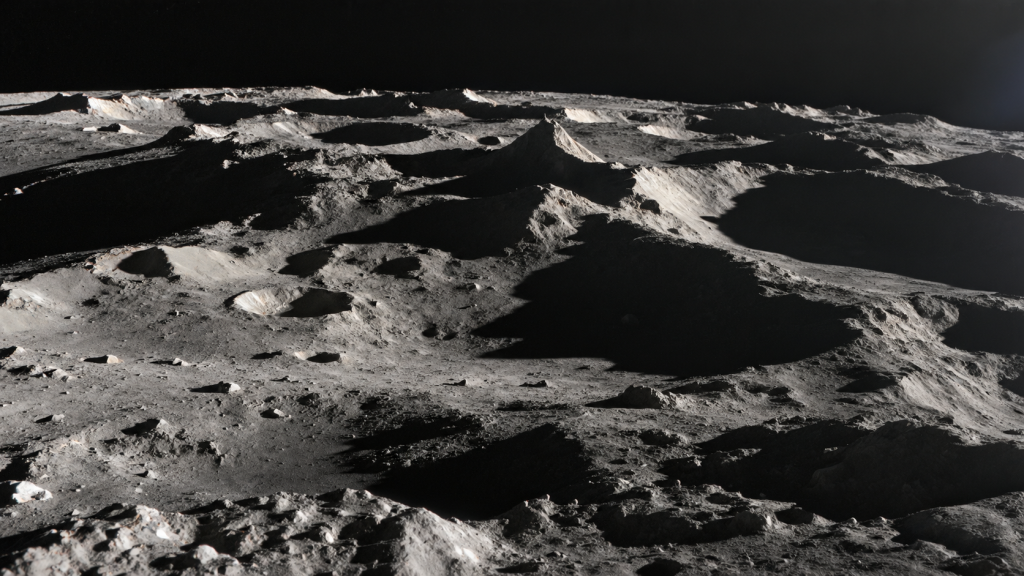
There is a reason the South Pole has become so important.
Resources.
Permanently shadowed regions near the lunar poles contain water ice.
That matters because carrying everything astronauts need from Earth is enormously difficult and expensive. If explorers can learn how to use resources already available on the Moon, the equation begins to change.
Water could support astronauts.
Oxygen could potentially be extracted from lunar materials.
Resources could eventually contribute to producing fuel or construction materials.
Instead of transporting every piece of a lunar settlement hundreds of thousands of miles from Earth, future crews might eventually manufacture or extract some of what they need right there.
That’s when a temporary outpost starts becoming something much more significant.
From Lunar Landing to Lunar Base
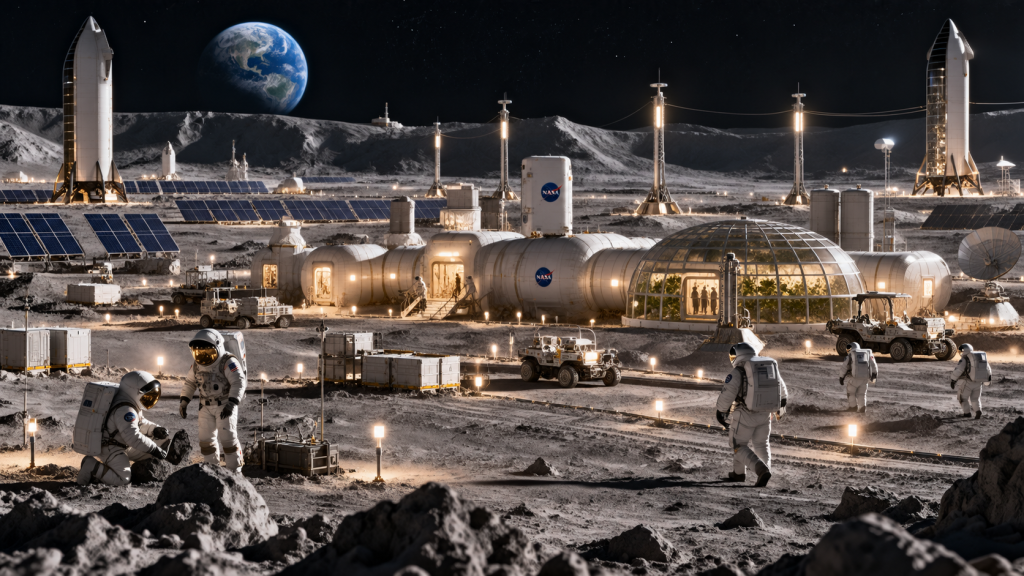
Artemis IV won’t build an entire Moon base during a week on the surface.
It doesn’t have to.
What matters is whether it can become part of a system in which every mission makes the next one more capable.
Artemis III tests the docking.
Orion carries astronauts through space.
Commercial landers take them to the surface.
Cargo missions deliver equipment.
Rovers provide transportation.
Robots multiply what a small crew can accomplish.
Power systems keep everything operating.
Habitats allow astronauts to stay longer.
Lunar resources could eventually reduce our dependence on supplies launched from Earth.
Put those pieces together and something begins to happen that never happened during Apollo.
The landing site starts becoming an outpost.
The outpost starts becoming infrastructure.
And eventually, that infrastructure could become a genuine human base on another world.
Apollo answered the question of whether humans could reach the Moon.
Artemis is attempting something harder.
Can we learn how to live and work there?
After more than half a century away from the Moon, we may finally be ready to find out.