In the last post we were far from Earth.
Out beyond the familiar planets.
Past the orbit of Neptune.
Drifting in silence with Voyager — carrying music, images, and a snapshot of human life into interstellar space.
Now we’re back.
Re-entering the solar system.
Burning through Earth’s atmosphere.
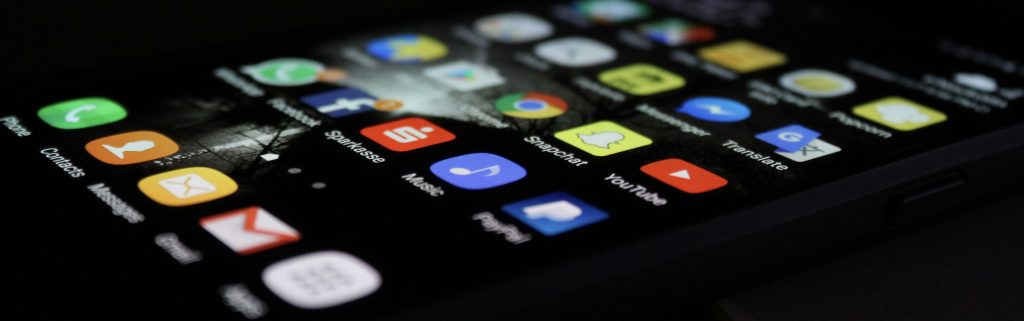
Standing on solid ground again, gravity pressing down, eyes fixed on a glowing rectangle in our hands.
A smartphone.
And a quiet question follows us back to Earth:
Are apps — these icons, screens, and taps — really the final form of how we’ll interact with technology?
History suggests otherwise.
Now it’s starting to disappear.
Apps Aren’t Going to Last Forever
Apps feel permanent because they’re everywhere. But permanence has never been a feature of technology — only a phase.
Before apps, we had websites.
Before websites, we had desktop software.
Before that, command lines and blinking cursors.
Each era felt complete while we were inside it.
Apps didn’t appear because someone predicted them decades in advance. They appeared because touchscreens made them convenient. They were a response to hardware, not destiny.
And now, hardware — and intelligence — is changing again.
Why Apps Worked So Well (For a While)
Apps solved a real problem.
Computers didn’t understand us. So we learned how to understand them. We clicked buttons, navigated menus, memorized workflows. Apps grouped functions into tidy containers because software needed structure.
Want to watch a video? Open the video app.
Want to talk to someone? Open the messaging app.
Want directions? Open the maps app.
Apps were not intelligence — they were organization.
They worked beautifully in a world where software needed to be told exactly what to do.
That world is fading.
When We Stop Touching Software and Start Talking to It
Artificial intelligence changes the relationship.
Instead of translating intent into taps and clicks, we can now express goals directly — through language.
“Help me plan this.”
“Show me what matters.”
“Capture this moment.”
Once software understands intent, the boundaries between apps start to loosen.
Why open five different tools when one system understands the task end-to-end?
Why jump between interfaces when context can follow you?
This isn’t the disappearance of apps — it’s the beginning of their transformation.
The Metaverse: Apps Stretching Into Space
This is where the metaverse enters the picture.
At its core, the metaverse isn’t about headsets or avatars. It’s about apps expanding beyond flat screens.
Instead of opening separate apps for work, play, creation, and communication, the metaverse imagines shared digital environments where those activities blend together.
A meeting isn’t a video app — it’s a space.
Entertainment isn’t a feed — it’s an environment.
Creation isn’t a tool — it’s something you move through.
The metaverse is apps dissolving into worlds.
It hasn’t fully arrived yet, but the direction is clear: fewer windows, more continuity. Less tapping, more presence.
And it’s still only a transitional step.
From Apps to Agents to Physical Systems
The next evolution pushes beyond virtual spaces entirely.
Imagine what happens when intelligence leaves the screen.
Instead of opening a camera app, a small drone hovers nearby — adjusting angles, framing shots, editing in real time as you move. You speak naturally, and it responds.
Instead of holding a phone to record a video, you walk and talk, and the system becomes your cinematographer.
Instead of opening a navigation app, your environment simply guides you.
Popular apps don’t vanish — they become roles.
• Video apps become autonomous camera systems
• Social apps become ambient communication layers
• Creative apps become collaborators
The interface doesn’t disappear — it relocates.
Touchscreens Were a Phase Too
Touching glass feels natural now, but it isn’t the end of the story.
We moved from:
• Typing
• Clicking
• Touching
• Talking
• Being understood
Each step reduced friction.
Each step made interaction feel more human.
The next steps may involve gestures, wearables, presence — and eventually, interfaces that respond directly to neural signals. Brain-computer interfaces are still early, but they point toward a future where intention itself becomes input.
No menus.
No icons.
No screens required.
That’s not science fiction — it’s the same trajectory we’ve been following all along.
Technology Isn’t Disappearing — It’s Moving Closer
Apps won’t suddenly vanish from your phone.
But they will feel less central.
As intelligence becomes embedded — in devices, robots, environments, and systems — software stops being something we open and starts being something we live alongside.
Not invisible.
Just no longer demanding attention.
Like electricity. Like gravity. Like air.
Back on Earth, Looking Ahead
Voyager continues outward, silent and patient.
Here on Earth, we keep tapping screens — for now.
But just as no one predicted the app era before touchscreens existed, we shouldn’t assume this moment is the final one.
Apps are not the destination.
They’re a waypoint.
The next interface won’t look like an app.
It may be a hologram, or it may be so small it won’t look like anything at all, just something you speak to.
And that won’t be the end of technology — just the next chapter in how we meet it.
Next Chapter: Robots, Physical AI, and the End of the Screen.