What time really is—and why understanding it matters for our future beyond Earth.
There are a lot of things we all want to get done in a day, and I’m no different. I kept noticing that it would be eight o’clock at night before I realized it—and nothing meaningful had gotten done. So I decided I needed to start wearing a watch again. I went to the department store.
I didn’t buy an Apple Watch to keep time.
I bought it to track it.
Keeping time suggests control—as if there’s a single clock everyone agrees on, like we’re all watching the same hourglass. But time doesn’t work that way. Every observer experiences it differently. Tracking time, on the other hand, made me aware of how my experience of it was unfolding—and that awareness felt like discovering something hidden in plain sight. Almost like magic.
Wearing the watch made time feel intentional. Active. Like I was chasing it—trying to understand where it goes, why it slips away, and how much of it I actually have. The watch didn’t give me more time, but it changed how I experienced it.
That’s when I started thinking more seriously about what time actually is.
We often talk about time as if it’s something separate from the universe—a background clock ticking away while reality plays out in front of it. But what if time is the universe unfolding? What if time isn’t something the universe moves through, but something the universe is?
I keep coming back to an image I first heard in a physics lecture: the universe as a movie reel. A continuous sequence of frames flowing smoothly forward. We experience those frames in order and call that experience “time.” As far as we know, time isn’t discrete. It doesn’t jump in chunks. It doesn’t pause. It doesn’t hesitate. It just flows.
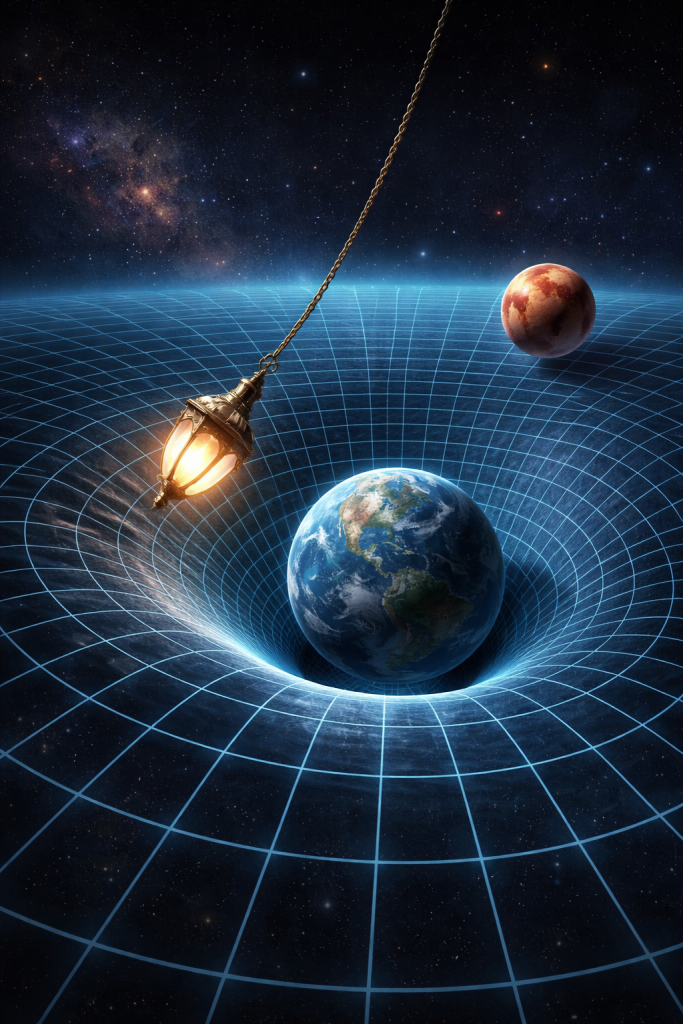
A visual metaphor for spacetime curvature, motion, and time measurement — from Galileo’s pendulum to the path from Earth to Mars.
Wherever and whenever something happens—that combination of where and when—that’s an event. Space and time aren’t separate things; together they form spacetime. Three dimensions of space, one of time. Every event that has ever happened, or ever will happen, exists somewhere on that structure.
This is where our understanding of time began to change.
Newton imagined time as something that simply marched forward—widening toward the future and narrowing again when you looked backward. Einstein changed that picture completely. In his view, the future and the past form symmetric light cones—one expanding forward from a given point, one expanding backward—both bounded by the speed of light. Time doesn’t just flow; it limits what can happen, and when.
The speed of light acts as a boundary for cause and effect. Time itself can stretch or compress depending on motion and gravity, but nothing outruns light. What happens now determines which future events fall inside our reachable cone—and which remain out of reach.
That’s where gravity gets interesting—and maybe misunderstood.
Gravity may not be a force in the way we once imagined it. It could be something that emerges from mass in motion: rotation, orbit, and large-scale dynamics. Earth spins. Earth orbits the Sun. The Sun moves through the galaxy. Galaxies rotate. Black holes spin. Motion layered on top of motion, like interlocking gears turning at different speeds.
What we call gravity may be how spacetime behaves when massive systems move.
Time bends near mass. Time changes with velocity. Not because clocks are wrong, but because time itself behaves differently depending on how matter and motion are arranged.
Which means the clocks on our wrists aren’t measuring time itself. They’re tracking our experience of motion through spacetime—one path through a much larger, dynamic system. A local rhythm inside a cosmic one.
That distinction matters when we talk about Mars.
Traveling to Mars isn’t just about distance—it’s about how time behaves along the journey. Move fast enough, and time slows relative to someone who stays behind. Leave Earth, loop through space at extreme speed, come back—and what feels like moments to you could be years for everyone else.
I finally wrapped my head around that not as science fiction, but as geometry. Two paths through spacetime. One tight and fast. One wide and slow. Both real. Both valid. Just experienced differently.
And that realization reframed Mars for me.
Mars isn’t just a destination. It’s a future event.
Right now, Mars exists in our future timeline, not our present one. To get there, we don’t just build rockets—we design the future first, then work backward. We pull that event closer by increasing collective motion now: more engineers, more coordination, more shared intent.
That’s where entropy enters the picture.
To reach Mars sooner, we need to create more organized complexity in the present. Delay collaboration and the timeline stretches. Align effort and the future compresses. Mars moves closer not just through propulsion, but through participation.
Energy and mass matter here too. E = mc² isn’t just an equation—it’s a reminder that mass and energy are interchangeable. We don’t necessarily need bigger machines. We need smarter concentrations of motion, energy, and intention.
And this idea of using time—not just watching it pass—shows up somewhere else too.
Music.
A whole note takes a fixed amount of time. But you can divide that same duration into half notes, quarter notes, eighth notes, sixteenth notes—even smaller subdivisions that computers can now slice almost infinitely. You can play one note, or you can play sixteen notes, and it all fits into the same temporal space.
Nothing magical happened to time—we just used it differently.
The magic happens when the music plays.
That’s what technology does. That’s what human creativity does. It doesn’t create more time—it increases what can happen inside it.
Which is why time isn’t something we’re losing.
It’s something we’re moving through.
If physics shows us how time bends, music shows us how humans have learned to live inside it—and sometimes send it across the stars.
And if we want to reach Mars—or understand the universe more deeply—we don’t capture time by staring at clocks. We capture it by understanding how it bends, how it flows, and how motion—human and cosmic—shapes the path forward.
To get to Mars, we don’t just travel through space.
We ride the curves of spacetime itself—and we decide, together, how long the journey has to be.
⸻